Author Archives: administrator

Essential Nutrients for Athletes

Athletes indulge in high intensity exercises and rigorous fitness regimen to keep themselves fit and able to handle the strains of their professional needs. While the level of their workouts are significantly high, it is a no-brainer that their bodies will need to be supplemented with as much food and in high nutrition, to be able to perform to their best, and to recover swiftly from the fatigue. Generally speaking, athletes need a bit of all the nutrient groups, with the exception of fat, which should be minimal. Here are the most important nutrients for athletes and their health and well being.
– Calcium: From a young age, we are fed milk in the promise that it will help us grow strong bones and be strong as we grow older. The same logic continues to apply in the context of athletes, especially because their training and physical capacity as athletes is centred around strong bones and muscles, as their capacity to move about with agile and speed driven movements makes them what they are.
– Iron and Folate: Iron is extremely important to keep blood haemoglobin levels up, and buoyed significantly, and this is vital in an athlete whose breathing has to be in order. Iron helps keep the oxygen levels in the blood at a stable rate, so that there is no fatigue and exhaustion setting in. Ideally up to 8 mg per day for men and 18 mg per day for women can set things in order.
– Magnesium: Magnesium helps athletes especially because it can stimulate high level energy in spiking metabolism, and is essential for those who train with very rigorous and strenuous sessions.
– Sodium and Potassium: When athletes train, they lost a lot of water and salts from their body from a lot of sweating. Consequently, there is a need for electrolytes to take over, and this is where sodium and potassium find use. The muscles in the body contract and relax, and the fluid balance remains stable. Hydration is vital in an athlete’s body for his functioning, and to this end, sodium and potassium are very important nutrients as they ensure that the body remains hydrated.
– Vitamin B12: Vitamin B12 is very important in the synthesis of fat and protein, to release the energy that is necessary for the body to function. This need is doubly amplified in the case of athletes who need to keep their energy levels high to take on the demands of their sports.
– Vitamin D: Vitamin D is important for healthy bones and strengthened muscles. Athletes are constantly on the move and have to keep their body buoyed sufficiently in order to remain high on their fitness quotients. Exposure to sunlight in generous doses can give them the much needed Vitamin D boost.
– Vitamin E: Vitamin E is vital for the body’s immunity and health, by helping one overcome infections by viruses and microbes. It is also a vital nutrient for good circulation, and is essential for an athlete to remain robust and agile.

References:
http://healthmeup.com/news-diet-fitness/6-essential-nutrients-for-athletes/15042099
http://chiro.org/nutrition/FULL/Essential_Nutrients_for_Endurance_Athletes.shtml
http://www.webmd.com/fitness-exercise/nutrition-tips-athletes

Photo Courtesy : Healthmeup.com

Walking Boosts Brainpower

Did you know that exercise sharpens your brains abundantly? And did you know, zooming in even further, that walking can actually power your brains even more, and improve your mental faculties by leaps and bounds? Here is how that operates!
Walking has been scientifically proven to be linked to brain growth. In 2010, a study was conducted, revealing that older adults who walked a distance over 40 minutes about three times a week for a year showed signs of brain growth in the hippocampus, which is associated with spatial memory. This study also showed that individuals with very low levels of fitness and individuals in their 60s and 80s still show benefits with respect to brain health and cognitive development. In simpler terms, walking keeps the brains sharp, and capable of retaining knowledge.
With exercise of any kind, walking included, there comes greater energy and increased metabolism. This automatically keeps away a lot of lifestyle diseases, because the body becomes more pruned towards activity, and the ill consequences of a sedentary lifestyle do not subsist. In 2006, there was a review of 70 studies which all showed that there was an increase in energy when one worked out.
Exercise is known to have a good impact on the mental health of a person, in that it sharpens one’s mind and body. People are known to have been alleviated from such conditions as depression and mania, through sustained efforts in staying exercise oriented – and what’s more, exercising and walking can assist may work better than antidepressants!
Walking also creates better and stronger joints in age. One finds their joints creaky and weak where there is a manifestation of lethargy and sedentary and averse lifestyle choices. Walking is an inexpensive and simple method that works to help keep your joints supple and well supported so your body feels stronger and more able.
Walking has been proved to be a great preventive factor of premature death from cardiac issues. People who are physically active remain at a lower risk of many sudden death syndromes that come from non-exercise.
Walking encourages greater blood circulation as your body experiences movement and interface with different spaces. This helps you remain healthy and well coordinated, while you stay mobile for long, in life.
No matter what your age or lifestyle choices maybe, walking is a great thing for you. Get off your couch and get moving!

References:
http://www.mindbodygreen.com/0-17999/walking-boosts-brainpower-4-other-reasons-to-exercise-every-day.html

Picture Courtesy : hantswalk.org

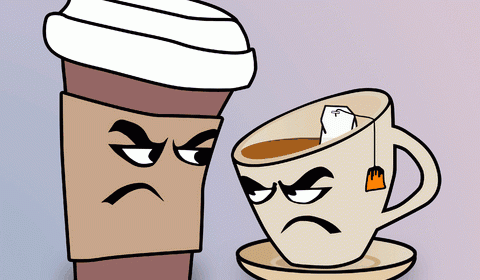
Which is healthier, Coffee or tea?

The discussion for today’s show was the age-old debate. Which is healthier, Coffee or tea? The expert guest on the show today is Ms. Muthulakshmi, a noted Nutritionist and Kinanthropometrist. Kinanthropometry is not just a hard to pronounce word; it is the study and analysis of body composition and measurements. Muthu says she herself is a coffee person. She has the habit of starting her day with coffee & a good breakfast. Coffee kick starts your adrenaline, and is the right boost that most people need to start their day.
Legend says that Tea was originally discovered by the emperor of China 2737BC. He was boiling water when tealeaves fell into it. He liked how it tasted, and found it soothing! Soon it spread through the country and Asia as a popular beverage. Coffee, according to legends, was discovered by a goatherd who found his goats to be very hyperactive after consuming some berries. Monks later consumed coffee, as a beverage, as it kept them alert enough to meditate for long periods of time. Both the beverages originated in the east.
The first caller for the day is Venu. He is primarily a tea drinker. He drinks both Green tea and masala chai. He says besides enjoying the taste of it, he also has heard people say that tea is good for health. He had a coffee fixation earlier in life, but stopped because he didn’t want to develop a caffeine addiction.
Muthu chips in, saying that both coffee and tea both have their own benefits. Coffee gives an adrenaline rush and energy, whereas tea is loaded with antioxidants. She says that the healthiness factor depends how you take it. Taking black coffee or a green or black tea is always healthier than adding milk to it. She says that if you are a coffee or tea lover, you may as well try to make it healthy.
Filter coffee has more benefits that instant coffee, and is even healthier without milk. Coffee has two to three times higher caffeine content than tea and is therefore easier to get addicted to! Another good tip is to add cinnamon to green tea as it boosts the fat burning qualities of green tea.
The next caller is Elton. He’s always woken up to a hot cup of coffee or tea in the mornings, and loves both equally. Nowadays he wakes up with hot water with lemon and alternates between coffee, green tea and chamomile tea alternately through the day. He says chamomile tea is especially good to have before bed as it has no caffeine content.
Another caller, Raghuram, chimes in with his two cents. He says he also loves both coffee and tea. He says he starts the day with coffee and follows it up with tea later in the day. He says that the newspaper while sipping on filter coffee is the perfect way to start your morning! He points out that adding sugar is not very good for your health. He also advises listeners to avoid coffee after 3pm as the caffeine takes 7 hours to leave the system.
Muthu gives a tip to tea lovers – She says that if you like green tea, make it with green tea leaves rather than the teabags to get the most benefits from it. She also clarifies that flavoured tea doesn’t affect the nutrient content.
The last caller for the day is Madhu. He used to be a coffee addict and used to take 10 shots of espresso a day! Now he switched to green tea completely at the advice of his Doctor. His addiction ended up affecting his health and his work. Now he’s down to 2 cups of green tea a day and is much healthier. He admits that he gets quite tempted by coffee cravings, but has so far remained strong! His espresso machine has become a mere showpiece at home.
The show concludes with a final thought fro Muthu. She advises listeners to go ahead and enjoy their coffee or tea, but no matter what their preference is, just don’t get addicted to it!

Picture Courtesy : itimes.com

Ways To Use Stress

Did you know that stress is actually your body telling you something? It tells you that you are out of balance, and that you need to step back for a bit to ensure that you get back on track.

Stress is actually important: but too much of it can be disparaging. There are many ways to make sure that stress is at its minimum, and that you really focus on yourself in life to ensure that you feel good about moving from one day to the next. Here are some really simple steps to make sure that you lead a happy and stress free life.
– Listen to what your body is trying to tell you. Are you sensing a tension headache? Do you feel a little under the weather? Do you feel anxious or tired? Do what it takes to give your body the attention it needs. Spend time in the quiet, unwind, and let your body repair and reconstruct itself before you pick up strings and move on with life. If you push your body beyond limits, remember, it won’t be able to respond efficiently!
– Be your own friend: Sometimes, we set unrealistic goals for ourselves, and expect too much out of ourselves. This is both dangerous and impractical. It is necessary to start by loving yourself enough to understand your limitations and capabilities, and to function accordingly. This will give you positivity and encourage you to feel better about the many things you need to attend to.
– Do a lot of physical activity in a day. This does not mean hitting the gym with a mean vengeance with no energy left to spare: but rather, to move about, to do your exercise, and to incorporate mobility in your lifestyle. It is a good way to get sedentary energy – which is the hub of negative thinking – up and moving. When you do that, you find yourself better disposed to work more efficiently.
– Eat, but eat to stay healthy rather than to stuff your face like there is no tomorrow. Eating healthy food in moderate portions, while also hydrating yourself is a definite way to making sure that you remain healthy in mind and in body without any hindrance to your wellbeing.
– Spend time doing nothing, so that you can recharge and get back into the fold. Life makes a lot of demands on you from different quarters – work, family, friends and the like. You need to find yourself a space to allow your own needs to be heard and attended to. Nothing does that better for you than yourself.
Stress can be very disparaging if left unchecked – and the key to making sure that you stay on the right side of good health with stress is yourself. Make an investment in your wellbeing and be committed to following through with all your efforts to siphon out stress. In the years to come, your mind and body will thank you for doing that!

References
http://www.mindbodygreen.com/0-18313/7-ways-to-use-stress-before-it-uses-you.html

Picture Courtesy : generationnext.com

Summer Superfoods

With the rising temperatures this summer, one invariably experiences intense thirst and heat – not to forget the awful dehydration and skin issues you wind up facing. Ayurveda says that summer is the season of pitta, where the digestive fire is supposed to be low, and one’s appetite is reduced considerably. It is important that we eat appropriately to balance the three doshas in our bodies in order to do justice to our health.

With summer setting in, our bodies tend to pivot towards drinking and eating cold stuff rather than warm. But, drinking very, very cold drinks tends to make your body struggle by putting out its inherent digestive fibre. Instead, therefore, it is good to have certain kinds of drinks that are not too cold. Moreover, avoiding food that is heavy, fried, rich and spicy or salty, for they are too much effort to digest, causing your stomach and digestive system much inconvenience. Here are some of the food options we can indulge in:

– Coconut Water is a fantastic form of electrolyte water, given that it is enriched with minerals and vitamin C. It is nature’s gift to you to help cool your system down.
– Sugarcane juice: The unrefined form of sugar is perfect for your body’s energy levels, and a great way to keep sunstrokes at bay. Sugarcane restores the pH balance in your body because of its inherently alkaline nature, while also enriching you with nutrients such as iron, potassium, calcium and magnesium, along with Vitamin B.
– Curd is a great source of probiotics, and helps your body tremendously thanks to the amount of calcium, Vitamin K, Vitamin B5, and Vitamin B12, which helps regulate cortisol in your body. Curd is even better when taken as buttermilk, and doesn’t even need to be terribly cold for you to cool down.
– Cucumbers should also be on your list this summer! Perfect as a salad addition, or even when juiced up with fruits. Cucumber has a lot of water in it, while also being enriched with Vitamins A, C and folic acid in the peels.
– What is summer without Watermelons? The beautiful red fruit is enriched with plenty of water, and lots of minerals like beta carotene, and nutrients such as Vitamins B1 and B6, helps you stay hydrated and refreshed in summer. They also work well to replenish your system while also filling your stomach.
– Come summer and it is time for Mangoes! Especially when raw, mangoes are rich in Vitamins B and C, which help fight inflammation and strengthens the immune system ably. In addition, mangoes are known to prevent and treat heatstroke, nausea and gastro-intestinal disorders, while also keeping you hydrated.

References & Picture Courtesy:

http://healthmeup.com/news-diet-fitness/7-healthy-summer-foods-drinks/36138

Protect Your Eyes This Summer!

Come summer, and the soaring temperatures can be a terrible impingement on your body. One of the more vulnerable body parts to rising summer temperatures are your eyes. Be they allergies or infections, your eyes could wind up with anything from sore eyes, red eyes, conjunctivitis and migraines. We have some simple tips for you to follow to make sure that your eyes are protected and stay healthy this summer.

– Make sure that you protect your eyes from sunlight. The best way to do this is to use protective sunglasses of the wraparound kind, so that they absorb at least 99 percent of the Ultra Violet Rays – UVA and UVB – from the sun. Doing this will keep you away from suffering migraines and cataract.
– If you are a swimmer, or you choose to make the pool your respite avenue for the summer, make sure that you use goggles to avoid contracting eye infections and allergies from the water.
– When you look to clean your eyes, never rub or clean them with unclean hands. If you are outdoors, in public places, or have just returned from public places where you held onto different things, use hand sanitisers or wash your hands to get rid of infections before you touch your eyes.
– Never splash water inside your eyes, because this affects your tear film by washing it away. It is a protective layer for your eyes, so you should be washing your eyes only when dust gets in, or foreign particles enter them.
– Make it a point to wash your face and hands every time you are back home from outside. Summer, and the pollution make you vulnerable to contracting infections of every kind, so you need to make sure that nothing from outside – dust, grime, germs, allergents or infection, enter your eyes and leaves you with allergies.
– When you have a tendency for allergic reactions, avoid using perfumes and cosmetics, and avoid going around spaces that have dust, pollen, mould and even smoke. If you do wind up with an allergy, you can spot it by looking for signs of redness, itching, burning and puffiness. They may or may not be related to nasal allergies, so the best thing to do is to get in touch with your doctor.
– Another common occurrence is the accumulation of dead cells and germs, which results in bacterial infection, causing sties in your eyes. The key to avoiding sties is to ensure that you have good quality eyelid hygiene. How can you do this? Gently exfoliate your eyelids once in fifteen days in order to get rid of dead cells. Avoid using heavy cosmetics or cosmetics past their expiry dates, dirty towels and contaminated hands on your eyes.

References:
http://healthmeup.com/news-healthy-living/7-ways-to-protect-your-eyes-this-summer/35999

Photo Courtesy : healthable.com

Essential Nutrients for Your Child’s Development

The foundation of any person’s health starts with childhood: and one of the most significant elements in ensuring good health is a good diet. Eating right and in right portions from a young age is extremely important for the wellbeing, longevity and sustained development of an all round kind, of every individual. The building blocks to a good diet are nutrients, and are seven in number. Here is everything you need to help your children get the right quota of nutrients for their overall development.

Nutrient 1: Protein:

Proteins are valuable for the body as it assists in building the cells in the body, breaking food down to release energy and to help fight infections while also assisting in the transport of oxygen in the body. Children can derive great doses of proteins by consumption of lean meats, dairy, fish, eggs, nuts, beans and soya.

Nutrient 2: Carbohydrates
Carbohydrates are a very important source of energy, especially for children who are often occupied with lots of activity. There are two kinds of carbohydrates – refined and natural. Refined carbohydrates are bad and best avoided – so don’t ply your children with too much white rice, sugar and white bread. Instead, they should have more starches and fibres. Some of the food options you can incorporate for your children are brown rice, whole grain cereals and bread, potatoes, wheat-based pasta and even bananas.

Nutrient 3: Fats
While many believe that fats are bad, they really are not if they are taken in moderation. Fats are also a vital source of energy for children, but should be moderated in quantity as they are easily stored in their bodies and can cause obesity if unchecked. So as a measure, it is useful to note that fats comprise approximately 30 percent of your kid’s required dietary allowance. Some of the foods that contain healthy fats include whole milk dairy products, vegetable oils such as olive oil, coconut oil, soybean oil, and sunflower oil, meat, fish and nuts.

Nutrient 4: Calcium
Calcium is important for children as it helps build healthy bones and teeth and is thus vital for their health. Calcium is also an essential nutrient in nerve, muscle and heart function. Children should also get an equal amount of exercise for their bodies to synthesize and use Calcium. Foods rich in calcium include milk, yoghurt, cheese, cream, egg yolk, broccoli, dark and leafy greens, tofu and paneer.

Nutrient 5: Iron
Iron is also a very important nutrient for it helps in producing haemoglobin, which carries oxygen in the blood and transports it to the organs, and also myoglobin, which stores oxygen in the muscles. Iron is vital, but is found in traces, and is important for the formative health of children. To supply iron, the best resources are red meat, liver, poultry, spinach, iron-fortified cereals, oats, beans and nuts.

Nutrient 6: Fibre
Fibres are important to assist in comfortable bowel movement in children, and also in the prevention of heart diseases, cancer and lifestyle issues. Getting children to eat fibre can be difficult, so the key is to cook it for them in a way that will encourage them to eat it. Some sources of fibre include whole-grain cereals, fruits and vegetables, chickpeas, seeds, nuts, lentils and corn.

Nutrient 7: Folate
The final nutrient is Folate, which assists in healthy development and functioning of a child’s body cells. It is a form of Vitamin B and is necessary for the physical wellbeing of children. Folate rich foods are whole-grain cereals, lentils, chickpeas, dark and leafy vegetables and beans.

Picture Courtesy : dietsinreview.com

Best methods of Contraception

Today’s show revolves around a topic that isn’t discussed enough – What are the best methods of contraception available?
There are many things to consider while choosing the right kind of contraception. To identify which one works best for you, consult your General Physician.
Statistics show that in India, 77% of the women who have undergone sterilization in the last year had never used any other kind of contraception before and thought this was their best option.
The expert guest on the show today is Dr. Priyanka Mehta, a noted consulting Gynecologist. She says it is a topic that needs to be addressed – How not to get pregnant. She says that there is no such thing as “The best method” or a one size fits all solution. Every woman is different and the ideal method for a woman depends on her health, lifestyle and age. For a woman in her 20s, the contraceptive pill might be the best idea. In her 30s a Copper – T might be the best option. Some methods, like a certain kind of Copper-T, include hormone doses to regulate the cycle.
Jane asks the Doctor about the patients she has come across and how many women know what works best for them. How do you know which works best?
Dr. Priyanka tells her that they follow the “Cafeteria approach” – They display all the methods and options to the patient. Some temporary methods are contraceptive pills that are to be taken on a daily basis and vaginal rings that often come with hormone doses.
Jane asks whether the ring is safe. Dr. Priya assures her that it’s a very small device that causes no discomfort.
In 1951, India implemented Population Plan but we have only seen a continuously growing population that is currently 1/6th of the world. They both agree it’s probably because we don’t talk about things like contraception and birth control and consider all things related to them as taboo. The idea is to break that taboo on the show today.
Jane asks what are the effects of these taboos on the society.
Dr. Priyanka responds that the problem is that youngsters don’t have access to correct and reliable information. There’s always the debate of when to you start educating girls and boys on these subjects – School? College? When they’re getting married?
She thinks that ideally there should be sessions even in college that address anonymous questions of students.
Schools tend not to discuss the topic as it could be perceived as encouraging a certain kind of lifestyle, but Dr. Priyanka says that just because we do not talk about it, it doesn’t mean that youngsters don’t need to hear it. It’s not about promoting a lifestyle, but keeping them informed that if there is an emergency situation, there are safe options available to them.
Dr. Priyanka talks about the case of a schoolgirl who had unplanned sex, and conceived. She did not know what to do. Luckily she tracked down the Doctor online and approached her in time to get help. Young adults should be aware that there are safe options.
Even with increase of awareness in India, most married women still resort to procedures and sterilization. Contraception should be the responsibility of both the man and woman, and should always be an informed decision taken by both. India has a history of mass sterilization that goes as far back as the 1970s.
Young adults today use over-the-counter pills without consulting a Physician or taking into account their medical history or side effects.
Sometimes this can even result in prolonged bleeding or, in the case of an undetected ectopic pregnancy, could even be fatal. Dr. Priyanka advises that one should either take an emergency contraceptive pill within 72 hours of intercourse or visit a gynecologist.
Jane asks the Doctor when she thinks a conversation about unplanned pregnancy should start in a family.
The Doctor acknowledges that this is a difficult conversation for any family and a difficult question to answer. She herself has 2 daughters and she finds the best way is to be like a friend to the children and explain the process in terms they will understand. Children are curious by nature and if you do not give them the information they seek, they can get all of it, and even more misinformation from the Internet, so it’s always better they hear it from you.
Jane asks the Doctor whether she does get young adults looking for help after knowing they’ve conceived. Dr. Priyanka says that there are a few, but it depends on what they choose to do about it. She advises that in such a situation, they should either take parents into confidence or go to a gynecologist immediately. There is always safe help available to them.
Jane then takes Dr. Priyanka’s help in busting some common myths about contraception:
Myth- the morning after pill or emergency contraceptive pill is the only option.
Dr. Priyanka – The Copper-T is also a good solution for short or long term contraception, aside from condoms. She says it’s always better to plan for long-term contraception rather than take a morning after pill every time.
Myth- it’s hard to get emergency contraception when needed.
Dr. Priyanka – Some kinds are available only with gynecologists, for which you might need a prescription, but most are available over-the-counter
Myth- taking the emergency pill is the same as an abortion
Dr. Priyanka- it isn’t, as the pill it doesn’t allow fertilization.
Myth- the emergency pill has to be taken within 24 hours of intercourse
Dr. Priyanka – The emergency pill is effective for 72 hours after intercourse
Myth – taking a course of the contraceptive/ birth control pills make you gain weight.
Dr. Priyanka – they do not. Many women use these pills even to control PCOS or heavy bleeding and they can be used until any age
Myth- taking a course of the contraceptive/ birth control pill can make you infertile
Dr. Priyanka – this is not true. Once you stop any long-term contraceptive you could conceive even within the next month.
In conclusion, Dr. Priyanka says that we must talk about everything, be free and open and share. She refers the recent case of an AIIMS Doctor who committed suicide, as she could not deal with her husband’s sexuality and abuse alone. She feels that talking about it with people she trusted might have helped her.
Parents should nurture the kind of relationship where the kids feel that they can talk to them freely about anything, even topics like this. If you don’t talk to your kids, no one else will.
She advises listeners to live each day to the fullest, as each day is different n special. She also says to try to do one random act of kindness everyday.

Photo Courtesy: www.healthowealth.com

Right Way to Lift Heavy Objects

Did you know that your everyday activities can influence your physical fitness? Any healthy lifestyle must necessarily include as many activities that involve the basic bodily moments – squat, stretch, bend and reach. These may sound like typical exercise routine elements, but the fact is, that they are vital body movements that preserve your bone and muscle health. One of the most commonly occurring things in many people’s lives is the lack of movement: and a sedentary lifestyle.
Consequently, many people wind up injuring their backs when they bend down to try and lift something heavy – and these injuries are even more common when people are above thirty. Here are some of the things you can do to help yourself in such situations:

1. Try to avoid bending and lifting heavy things as much as possible. If you have things that you have to store around your space, it’s a wiser thing to store it on top of counters, or on shelves that may be overhead or at shoulder-level. This will help you avoid bending over and lifting heavy stuff.
2. If you simply must bend down, or lift something by bending over, here are a few things you should be doing:
o Stand close to the heavy object, ideally as closest as you can
o Spread your feet wide as though you are ready to squat
o Squat down till you reach the object, while keeping your feet on the floor.
o Bend over, but do not bend from your back and waist – rather, let your legs propel your bending motion.
o If you are lifting something heavy, perhaps a box or a suitcase, put one foot next to the thing you’re lifting, and one leg behind the thing. Hold onto it with your fingers and your palms, and begin lifting it.
o As you stand up and begin lifting the object, straighten up your legs and stand up.
o Always make sure that your back is straight all the time while you are lifting the heavy object – don’t hunch over.
o Once you hold the object and stand up, and turn your whole body if you want to change direction, so that you don’t have to bend from your waist while you are actually physically carrying the load.
3. When you are putting something down, you should follow the process backwards.
Always give your back the priority and ensure that you follow all of these pointers even if you are not lifting something heavy. Don’t use your back as a lever, rather, make your legs the propulsion to help you squat, bend and lift things. Once you practice this as a regular exercise, you will find your back functioning healthily.

References:
http://healthmeup.com/news-healthy-living/the-right-way-to-bend-and-lift-objects/15041469

Picture Courtesy : webmd

Work- Life Balance

You have a dozen things to do before it’s time for breakfast. You finish as much as you can, but it’s all still not done. But you need to be at work on time, so you rush out, grabbing a slice of toast and stuffing it into your mouth hastily on the way. You get into your car, and try to play the music you like, but the traffic is so heavy that you’re barely paying attention in the hope of getting to work on time. You make it in the nick of time and rush to your desk, where you find a whole lot of other things that need doing. You go through the day with your attention divided between many tasks, until you realise that it’s time to leave. By the time you’re home, you only want to crash.

A work-life balance is what’s missing, to help you find a way to juggle many balls while also taking good care of yourself. You might think this isn’t the case with you. But hold on. Here are a few things you need to keep an eye out for, to see that you don’t fall in the trap of all-work-and-no-play:

– You have no time for friends and family, and don’t show up to spend time with them on special occasions. By no time, it could also mean that you don’t spend time having quality conversations with them on the phone, or in person. There may also be a repetitive pattern of cancelling plans at the last moment in pursuit of work demands.

– You are always complaining about work. Whether it is your boss or the sheer volume of work that you are saddled with, you have something or the other to nitpick about when it comes to your career. You have no mental space for anything else.

– You are constantly in touch with all your work communiqué. Be it through emails on your smart phone or tablet, or a perennially switched on computer, you simply cannot stay away from checking in on your work email to see if you’re needed for anything.

– You have no room for hobbies because you think it eats into your work time. You do not exercise, or indulge in activities that take you out of the work sphere. Even when you do indulge in the one off event of this kind, you find yourself feeling very anxious and jumpy about not being on top of your game with work.

– You fall ill a lot – and they’re not major illnesses, but rather immunity related issues like colds, stomach infections and anxiety headaches. You find yourself popping pills by the number, and generally feel tired most of the time.

If you find yourself fitting into this niche, beware of where you are leading yourself. This is not a good situation to be in, admittedly a part of it is your own doing in not letting your personal needs have a place in your life. Work is, of course, a vital part of your life, but it isn’t everything. Step back a bit, and live in the moment. You have only one life to live, and it isn’t any use if you’re letting yourself down a spiral of ill-health.

References:

http://www.mindbodygreen.com/0-18290/7-signs-you-need-to-work-less-play-more.html

« Older Entries Recent Entries »